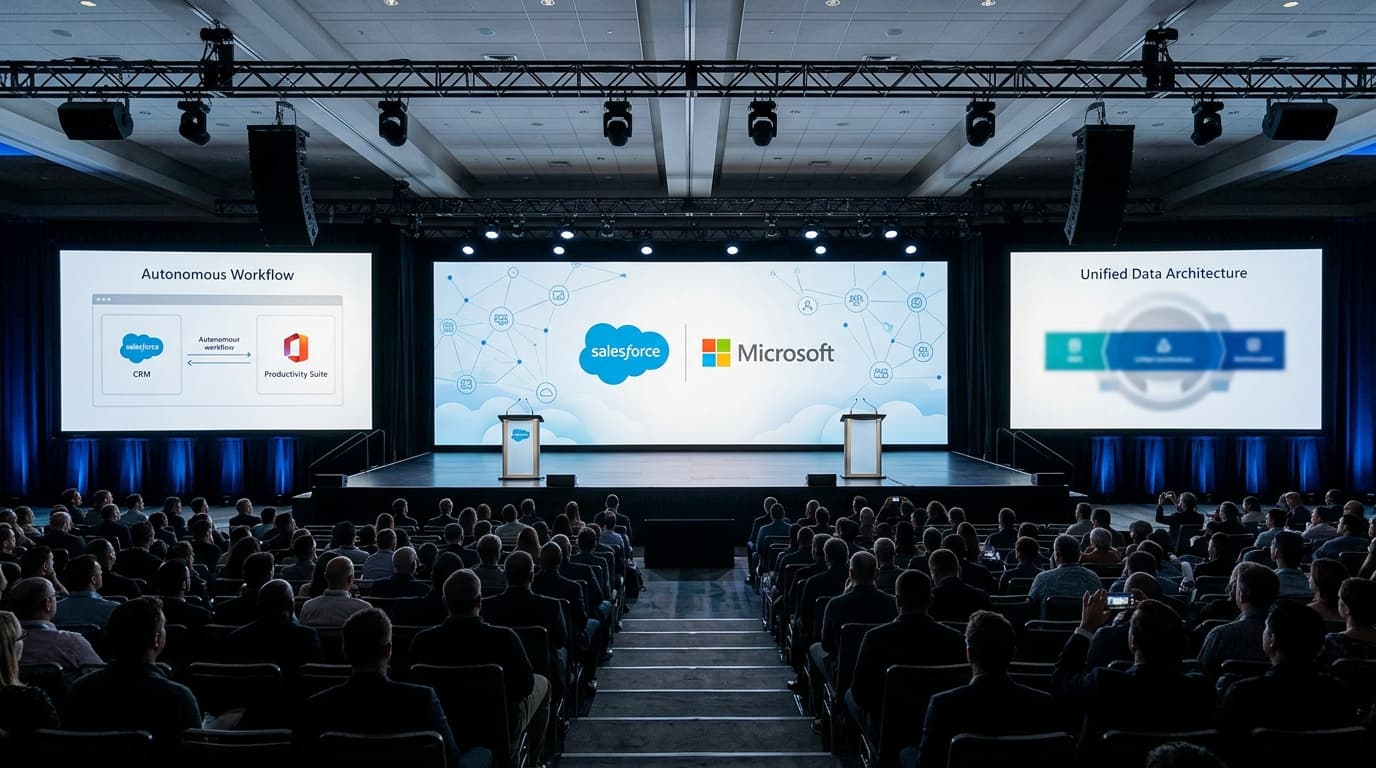
Strategic Ignite partnership
At the Microsoft Ignite conference in San Francisco, Microsoft and Salesforce announced Copilotforce, an enterprise integration that addresses one of the most persistent bottlenecks in modern knowledge work: the friction between day-to-day productivity suites and core customer relationship records.
Rather than treating artificial intelligence as a passive conversational interface, Copilotforce allows autonomous agents orchestrated by Salesforce Agentforce to execute multi-step operational tasks directly within Microsoft 365 applications such as Teams, Outlook, and Word.
MCP protocol and prebuilt skills
The engine behind this user experience is 'Salesforce in Copilot', a dedicated integration featuring over 38 preconfigured sales and account management skills. These skills operate through the Model Context Protocol (MCP), an emerging open standard that allows language models to discover capabilities and pull authenticated enterprise context securely.
Through MCP, commercial teams can conduct pipeline reviews, update opportunity stages, inspect renewal risks, and adjust forecasting records within familiar chat threads and meeting interfaces, ensuring that every automated write-back maintains full auditability.
Zero-copy architecture with Fabric
The deeper architectural achievement in Copilotforce is the bidirectional zero-copy data virtualization connecting Salesforce Data 360 and Microsoft Fabric OneLake. Historically, synchronizing customer records with corporate data lakes required complex ETL pipelines, creating latency and data hygiene challenges.
Under this federated virtualization approach, AI models and analytics workloads on either cloud can query customer transactions in real time without physically moving records between vendors, eliminating synchronization lag and maintaining existing access policies.
Accenture as Customer Zero
Global professional services leader Accenture has stepped in as the launch design partner and 'Customer Zero' for Copilotforce. The firm is operationalizing this unified framework across its own global sales infrastructure to evaluate agent performance under enterprise-grade transaction volumes.
This early implementation provides a valuable real-world template for other multinational organizations, establishing guardrails for autonomous CRM updates, user privilege delegations, and agent audit trails in mission-critical sales scenarios.
Catalan and European market impact
For enterprises based in Barcelona, Catalonia, and throughout the European Union, the partnership offers significant operational advantages within a stringent compliance environment. European regulations, including the GDPR and the EU Data Act, mandate strict oversight regarding data duplication and unauthorized cross-border transfers.
By employing zero-copy data virtualization, European companies can keep customer data localized within compliant cloud regions, while enabling cross-platform AI agents to retrieve context dynamically without violating data governance mandates.
- Representative breakdown of operational priorities observed among European technology leaders.
Enterprise readiness assessment
Deploying agentic systems that bridge distinct software platforms requires a mature underlying data fabric. Organizations must ensure that identity management, taxonomy definitions, and record authorization are harmonized before allowing autonomous agents to execute transactions.
The interactive assessment below helps evaluate where your organization currently stands in its trajectory toward zero-copy, agent-assisted workflows.
How does your organization currently connect CRM records with daily collaboration tools?
Enterprise governance outlook
The joint announcement from Microsoft and Salesforce underscores a broader industry evolution: competitive advantage is shifting away from proprietary walled gardens toward secure, interoperable agent networks. The ability to invoke trusted enterprise actions in the flow of daily communication will become a baseline requirement.
At basebcn, we anticipate that this shift toward zero-copy agent integration will prompt companies across Catalonia and Europe to rethink their data pipelines, favoring federated protocols that deliver both operational velocity and uncompromised compliance.
“Zero-copy interoperability changes how European enterprises balance agent-driven productivity with data residency and compliance.”