The Erlangen Milestone
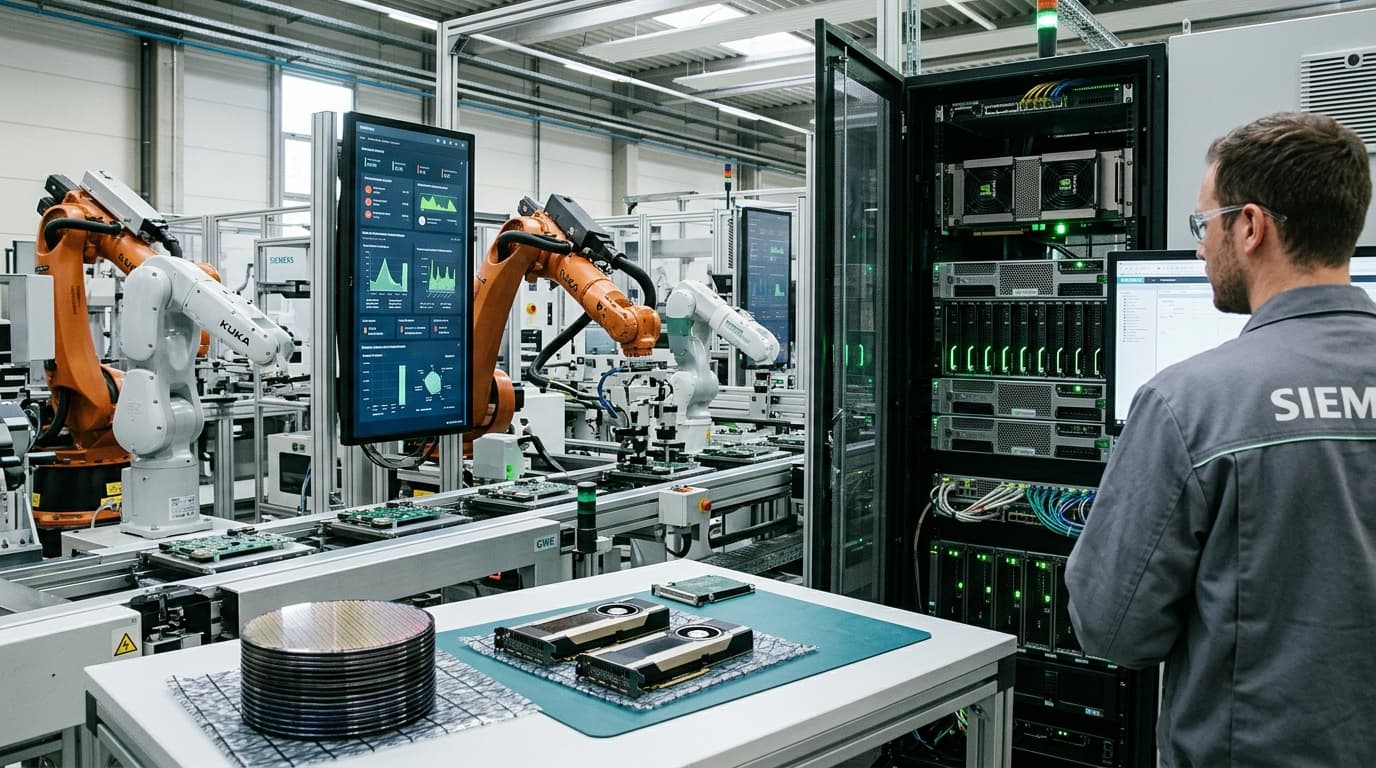
Siemens' electronics manufacturing plant in Erlangen (Gerätewerk Erlangen, GWE), Germany, has been established as the global reference blueprint for AI-powered autonomous and adaptive manufacturing. This live implementation marks a significant turning point: uniting high-fidelity virtual physics simulation directly with real-time physical plant operations.
Unlike isolated pilot projects, Erlangen is a continuous-production facility. The deployment demonstrates that merging physical AI, accelerated computer vision, and autonomous mobile robotics allows manufacturers to handle design modifications and volatile demand without sacrificing throughput or incurring costly maintenance shutdowns.
Real IT/OT Convergence
At the core of the system is the native handshake between Siemens Xcelerator industrial automation controllers (PLCs) and NVIDIA Omniverse physics-based digital twins. This setup allows decisions modeled in high-fidelity 3D synthetic environments to directly translate into deterministic motion control and logic instructions on the shop floor without protocol bottlenecks.
Edge computing plays a decisive role in this architecture. Rather than relying on cloud infrastructure subject to variable latencies that exceed sub-ten-millisecond machine cycle limits, industrial edge inference servers situated alongside assembly cells process dense visual feeds and sensor telemetry locally, validating every assembly step in real time.
Slashing Scrap and Setup Time
A major operational challenge in precision electronics and component manufacturing is the downtime required to retool fixtures and reprogram robotic manipulators when introducing product variations. In Erlangen, digital twins simulate kinematics and physical grip dynamics before sending validated configurations to live robots, drastically reducing setup windows.
Simultaneously, edge-based visual inspection models detect structural defects or soldering imperfections within milliseconds, ejecting non-conforming parts before they consume additional materials and energy in downstream assembly stages.
Capital Allocation Blueprint
Adopting this blueprint reshapes capital expenditure priorities across industrial facilities. Rather than directing budgets exclusively toward rigid tooling or fixed transfer machinery, capital is increasingly dedicated to local compute clusters, high-speed telemetry, and interoperable software fabrics.
Global distribution partners and industrial system integrators are restructuring their delivery models to support this hybrid architecture, wherein robust industrial hardware operates alongside enterprise graphics accelerators and modular digital twin platforms.
- Indicative breakdown of budget allocation across comprehensive plant modernization initiatives.
Implications for European Hubs
For manufacturing clusters across Europe—particularly in Catalonia's automotive tier suppliers, packaging machinery builders, and pharmaceutical facilities—Erlangen offers actionable operational guidance. Rising pressure to manage high-mix low-volume batches while adhering to strict European traceability mandates requires moving away from inflexible automation.
Industrial operators across Barcelona and Catalonia can leverage this model to upgrade installed equipment incrementally. Embedding edge vision layers and open communication standards enables mid-sized producers to add cognitive capabilities to legacy robotic cells without undergoing prohibitive greenfield overhauls.
Factory Readiness Assessment
Determining whether an industrial site is prepared to adopt adaptive manufacturing principles requires evaluating network latency, data governance, and the integration maturity between engineering models and shop-floor controllers.
Use this operational diagnostic to pinpoint strategic priorities for modernizing factory lines.
How is quality inspection handled across primary assembly lines?
Strategic Outlook
The blueprint established at Erlangen previews an industrial decade where European manufacturing competitiveness will hinge on operational agility rather than labor arbitrage. Standardized interfaces, resilient automation platforms, and accelerated edge compute establish the technical baseline for sustainable, high-margin domestic production.
Enterprises that treat physics simulation as an active operational asset rather than an offline design tool will effectively insulate their operations against supply chain shocks, delivering customized precision products with minimal lead times.
“The adaptive factory is no longer a theoretical vision: the convergence of physics simulation and live shop-floor control is now an operational reality.”