Launch at Fira de Barcelona
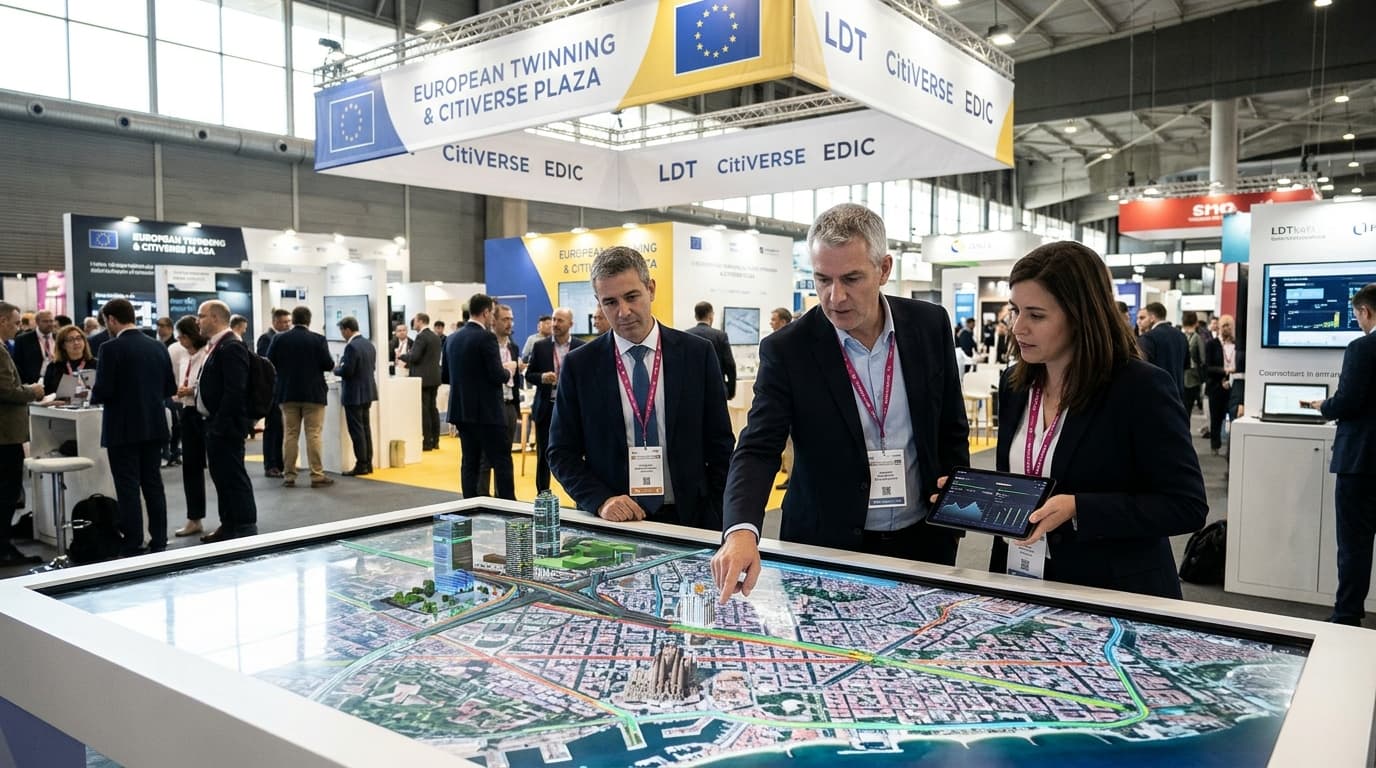
The Smart City Expo World Congress 2026 at Fira de Barcelona served as the launchpad for the European Commission's next major evolution in municipal computing. Coordinated through the Local Digital Twins CitiVERSE EDIC (European Digital Infrastructure Consortium) and the CitCom.ai Testing and Experimentation Facility, community authorities inaugurated the European Twinning & Citiverse Plaza in Hall 3 (Stand D71). The pavilion connects live operational data models from key cities including Barcelona, Valencia, Rotterdam, and Tampere.
The launch marks a definitive migration from fragmented local experiments into a federated pan-continental digital backbone. Aligned with the European Commission's Apply AI Strategy for liveable cities, the initiative equips municipalities with validated, open-source toolkits to predict flash flooding, dynamically optimize traffic congestion, and present predictive urban redevelopment scenarios through immersive citizen-facing 3D interfaces.
Moving Beyond Isolated Pilots
For more than a decade, municipal smart city programs have struggled under a fragmented pilot paradox. Local administrations regularly funded isolated proofs of concept built on proprietary stacks that inevitably languished or caused vendor lock-in once grant cycles expired. Establishing an EDIC creates a formal cross-border legal and technical vehicle, allowing European local governments to co-invest in standardized, shared AI capabilities.
By interconnecting municipal digital twins via Minimal Interoperability Mechanisms (MIMs), the EU ensures that an urban mobility algorithm trained on multimodal traffic data in Rotterdam can be seamlessly adapted and deployed across metropolitan Barcelona without rebuilding data ingest pipelines. This continuity lowers capital expenditure and dramatically shortens implementation cycles for small and mid-sized cities.
The EU Local Digital Twin Toolbox
At the core of this technical interoperability lies the EU Local Digital Twin Toolbox. Conceived as a modular suite of open-source software, reusable data connectors, and analytics libraries, the toolbox decouples urban operational intelligence from underlying proprietary databases. Municipalities can integrate IoT sensor streams, geospatial land registries, and satellite imagery into a unified, harmonized semantic data space.
This standardized framework fundamentally alters public procurement dynamics. Rather than issuing tenders for monolithic, single-vendor traffic or waste management dashboards, public authorities can procure modular components that snap directly into their open digital twin, preserving public data sovereignty and long-term architectural autonomy.
CitCom.ai and Real-World AI Testing
Complementing the software toolbox, the CitCom.ai Testing and Experimentation Facility (TEF) provides physical and virtual sandboxes where urban AI systems are stress-tested prior to live infrastructure rollouts. In Barcelona, four flagship EU initiatives—3DxVERSE, x-CITE, SENSE, and CitCom.ai—demonstrated automated algorithmic responses to severe transit bottlenecks and microclimate heat stress.
The CitCom.ai testing framework ensures that automated decision systems comply with strict benchmarks for robustness, fairness, and algorithmic explainability before municipal certification. This pre-deployment auditing de-risks public procurement, ensuring compliance with high-risk system obligations outlined under European AI governance frameworks.
- Indicative breakdown of operational use cases across 3DxVERSE, x-CITE, SENSE, and CitCom.ai.
GovTech Market Opportunities for Tech Integrators
For tech consultancies and systems integrators in Barcelona and across Europe, the establishment of the LDT CitiVERSE EDIC unlocks a mature, high-value GovTech market. Moving away from proprietary silos does not diminish private sector opportunity; instead, it shifts the value proposition from commoditized software licensing toward complex systems integration, local model fine-tuning, and robust data pipeline engineering.
Integrators proficient in EU LDT Toolbox architectures and CitCom.ai testing methodologies can compete across multiple member state public tenders simultaneously, unburdened by legacy vendor barriers.
What architecture underpins your current digital twin or municipal IoT platform?
Interoperability and Sovereign Urban Data
The strategic philosophy underlying the European Twinning & Citiverse Plaza extends well beyond software performance. By securing sovereign data spaces for European cities, the Commission seeks to prevent critical urban infrastructure operations—ranging from dynamic street lighting to emergency disaster dispatch—from becoming irrevocably dependent on non-European hyperscalers governed by conflicting extraterritorial laws.
Metropolitan pioneers like Barcelona have championed the principle that democratic technology governance requires verifiable source code, transparent data schemas, and auditable algorithmic weights. The EDIC legal framework ensures that local governments retain full regulatory agency over their computing environments while preserving citizen privacy.
The Road Ahead for European Smart Cities
The unveiling of interconnected twins at Smart City Expo World Congress 2026 establishes the baseline for a multi-year deployment wave across dozens of European municipalities. As the open modules of the EU LDT Toolbox expand and the CitCom.ai testing network certifies new specialized facilities, public procurement criteria will become substantially more unified and demanding.
For AI consultancies and technology engineering firms, sustainable growth will stem from adopting modular, transparent, and standards-compliant architectures capable of native integration into Europe's shared digital fabric. Urban digital twins have evolved from municipal showcases into the essential operational foundation for sustainable urban planning.
“The transition from municipal silos toward federated digital twin infrastructures is actively reshaping public sector tech procurement across Europe.”