The strategic pivot to on-device compute
For the past two years, enterprise generative AI strategies have centered almost exclusively on querying monolithic models hosted in centralized hyperscaler facilities via remote API calls. While this paradigm catalyzed rapid prototyping, it introduced persistent operational constraints: unpredictable bandwidth requirements, escalating token usage billing, and recurring concerns regarding data jurisdiction and sensitive intellectual property.
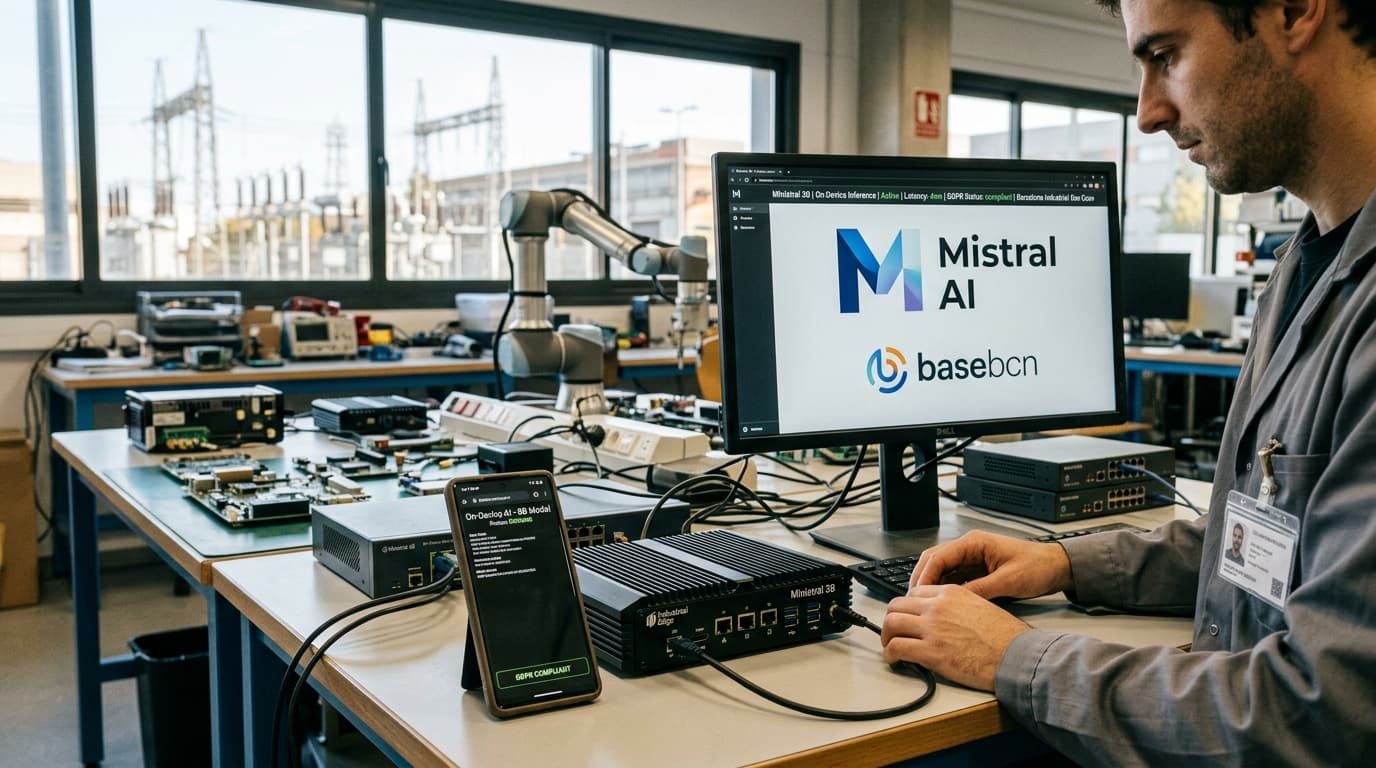
The debut of Ministral 3B and Ministral 8B by Paris-based Mistral AI marks a technical turning point. Collectively dubbed 'les Ministraux', these sub-10B parameter models are explicitly engineered to reconcile analytical capability with constrained compute envelopes, shifting intelligence directly onto endpoints such as modern enterprise laptops, smartphones, and local industrial controllers.
Architectural design and 128k context capacity
The core technical differentiator of the Ministral family lies in its native support for a 128,000-token context window within 3-billion and 8-billion parameter boundaries. Historically, smaller architectures were confined to 4k or 8k windows to avoid the quadratic memory overhead associated with key-value caching, preventing local systems from processing comprehensive documents or persistent conversation histories.
To mitigate this issue, Ministral 8B incorporates an interleaved sliding-window attention mechanism. This approach minimizes the active memory footprint during auto-regressive generation, yielding faster time-to-first-token metrics and enabling devices with standard unified memory configurations to handle extended prompts without thermal throttling or out-of-memory crashes.
Benchmark performance across reasoning tasks
On standardized benchmarks evaluating commonsense reasoning, mathematics, code generation, and instruction alignment, the Ministral series sets a new benchmark in the sub-10B tier. Ministral 8B reliably surpasses contemporaries such as Gemma 2 9B and Llama 3.2 3B across core benchmarks, while Ministral 3B demonstrates exceptional parameter efficiency relative to its compact size.
This balance is critical for operational deployments where models operate not merely as writing assistants, but as autonomous agents tasked with validating JSON schemas, parsing field telemetry, and issuing local execution calls without human oversight.
Sector distribution for edge AI workloads
Deploying capable compact models unlocks deployment environments where persistent cloud connectivity is technically unfeasible or economically disadvantageous. In modern manufacturing, logistics, and autonomous systems, deterministic latency is paramount; real-time quality control cannot tolerate round-trip latency to a remote server.
Concurrently, regulated sectors such as corporate legal practices, private banking, and public administrative offices find in on-device AI a robust solution to strict data residency mandates, as customer records remain strictly within the physical endpoint.
- Indicative breakdown illustrating expected distribution based on current edge inference feasibility.
Data sovereignty and GDPR compliance
For European enterprises, the decisive value proposition is regulatory compliance. Under the General Data Protection Regulation (GDPR) and the upcoming enforcement of the European Union AI Act, sending private customer telemetry or trade secrets to non-EU cloud environments introduces compliance hurdles and extensive auditing demands.
By hosting models like Ministral on local infrastructure or dedicated endpoint fleets, organizations maintain a strictly closed security perimeter. Confidential documents and health records are processed entirely within local RAM, mitigating data leakage vectors while simultaneously trimming commercial cloud compute bills.
Self-assessment: evaluating your edge AI readiness
Before migrating production workloads from cloud APIs to on-device architectures, enterprises must assess hardware compatibility, latency thresholds, and security parameters.
The diagnostic checker below provides an initial benchmark to determine your readiness for sub-10B model deployment.
What is the primary operational friction in your current AI pipeline?
Impact on the Barcelona and Catalan industrial hub
For Barcelona's thriving tech cluster and Catalonia's industrial belt, the arrival of 'les Ministraux' offers direct competitive leverage. Advanced manufacturing, chemicals, automotive engineering, and pharmaceuticals handle proprietary technical drawings and batch formulations that cannot leave local environments.
Simultaneously, the region's concentration of digital health and mobile software startups can now embed resilient cognitive features directly into their mobile clients, removing external API latency while insulating their gross margins against variable cloud usage tiers.
Strategic outlook for autonomous computing
The rise of high-capacity small language models does not signal the obsolescence of massive frontier systems, but rather the establishment of a tiered computational ecosystem. In this architecture, agile on-device models like Ministral handle real-time routing, redaction, and local reasoning, escalating only the most challenging ambiguities to central clusters.
Through this release, Mistral AI reinforces European digital sovereignty, proving that algorithmic refinement and compute efficiency are just as decisive in production AI as sheer scale.
“The shift toward capable sub-10B models fundamentally rebalances computational throughput, data privacy regulations, and cloud infrastructure expenses.”