A paradigm shift in software interaction
For decades, enterprise automation has been constrained by a stark architectural trade-off: either finance bespoke API connectors that require extensive engineering maintenance, or deploy rigid Robotic Process Automation (RPA) scripts that break whenever a UI layout shifts. Anthropic has introduced a third architectural path with 'computer use', a capability deployed in public beta within its upgraded Claude 3.5 Sonnet foundation model.
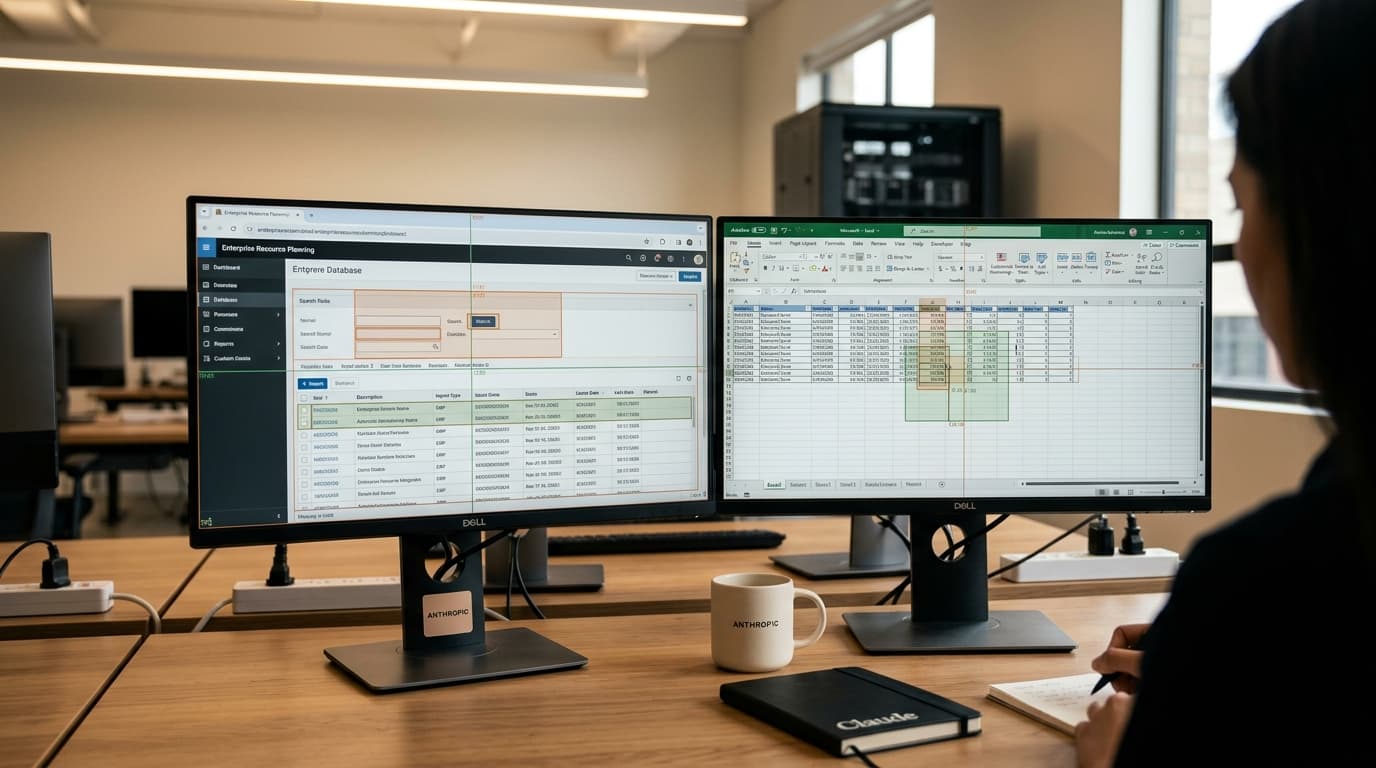
Available to software engineers via the Anthropic API, computer use empowers Claude to interact with desktop applications and web browsers precisely as a human operator does. Rather than relying on custom back-end hooks, the model views periodic screenshots, calculates exact pixel coordinates for buttons and forms, and issues native OS-level commands to move the mouse cursor, click interface elements, and input text.
Technical architecture: vision-driven agentic execution
Under the hood, computer use relies on a closed perception-action loop driven by the enhanced multimodal capabilities of Claude 3.5 Sonnet. The model receives an image of the current screen state, determines the sequential actions required to fulfill a prompt, and streams precise cursor movements and key combinations back to the host environment. When an unexpected pop-up appears or network latency delays a page render, Claude evaluates the updated screenshot and dynamically adapts its operational trajectory.
This fundamentally decouples automation from code-level access. Whether interacting with a twenty-year-old on-premise ERP client or a modern cloud project management dashboard, the model treats the software as an interface designed for human cognitive processing, eliminating the traditional requirement of API parity across enterprise toolsets.
Empirical benchmarks: doubling previous state-of-the-art
On OSWorld—an academic benchmark developed to evaluate AI agents across realistic operating system tasks involving multi-app workflows, browser navigation, and file manipulation—the upgraded Claude 3.5 Sonnet scored 14.9% in the screenshot-only evaluation category. This more than doubles the 7.8% achieved by the previous leading frontier AI model, establishing a new record for general-purpose visual operating system control.
While this score remains below the 70–75% baseline typical of experienced human operators, the magnitude of the improvement within a single model generation illustrates how quickly agentic models are closing the gap. In structured, repeatable workflows with defined boundaries, this performance level is already sufficient for high-value supervised execution.
Early production validation across enterprise software
Early enterprise testers—including Asana, Canva, DoorDash, and Replit—have integrated computer use to automate end-to-end tasks requiring dozens or hundreds of sequential steps across disconnected software tools. These production explorations demonstrate that visual agentic execution can handle complex multi-step journeys without bespoke middleware.
At Replit, the capability is being leveraged to autonomously test web applications by interacting with them through the browser, clicking interface buttons, submitting forms, and identifying UI discrepancies. At Asana, teams are exploring automated handoffs where customer requests are synthesized and pushed into project boards and CRM tools via direct UI manipulation, minimizing human data re-entry.
Strategic implications for European mid-market enterprises
Across Barcelona, Catalonia, and the wider European mid-market, organizations in logistics, manufacturing, wholesale distribution, and professional services often operate on complex, fragmented software portfolios. Legacy on-premise ERPs frequently sit alongside specialized vertical SaaS tools and offline spreadsheets, creating operational silos that have proven difficult and expensive to connect.
Building custom API integrations or undertaking massive ERP overhauls is often financially impractical for mid-sized firms. By automating workflows directly through graphical interfaces, businesses can link disparate legacy and modern software environments at a fraction of traditional systems integration costs, bypassing vendor lock-in and avoiding protracted software replacement cycles.
- Indicative breakdown of corporate software landscape typical among European mid-market organizations.
Assessing your readiness for GUI agent deployment
Adopting AI agents that control desktop cursors requires a structured approach to access management, operational risk, and human oversight. Technology leaders must evaluate whether their core operational pain points and governance frameworks are primed for visual automation.
Take this strategic readiness self-assessment to identify how computer-use capabilities can most effectively integrate into your organization's digital transformation roadmap.
Which software layer accounts for the highest administrative burden in your operations?
Security, sandboxing, and European regulatory compliance
Granting an autonomous system the ability to execute mouse clicks and keystrokes introduces security considerations distinct from traditional LLM chat applications. Within the European regulatory landscape, governed by the GDPR and the evolving provisions of the EU AI Act, agentic desktop control requires isolated execution environments (sandboxes), explicit credential boundaries, and comprehensive audit logs.
Anthropic has explicitly positioned this initial release in public beta to give enterprise development teams time to stress-test safeguards. Critical enterprise actions—such as executing financial disbursements, modifying production databases, or signing corporate contracts—must remain anchored to strict human-in-the-loop validation, ensuring that visual misinterpretations do not trigger irrevocable business errors.
The road ahead: human-agent operational symbiosis
The arrival of GUI-controlling agents is not about displacing knowledge workers; it is about reshaping daily operational roles. Just as spreadsheets eliminated manual recalculation in favor of strategic scenario modeling, visual agents will increasingly relieve administrative teams from the friction of manual data transcription, cross-tool copy-pasting, and repetitive compliance checks.
For forward-looking enterprises in Barcelona and across Europe, building early institutional familiarity with agentic workflows offers a durable operational edge. Organizations that implement pragmatic, well-governed pilots today will be best positioned to scale their operational capacity without proportionally scaling administrative overhead.
“Direct GUI control bypasses the historical barrier of costly custom integrations, offering mid-market firms a pragmatic path to automation.”