The Last-Mile Efficiency Challenge
The final leg of parcel delivery remains the most expensive and operationally complex segment of global retail supply chains. In congested metropolitan areas, delivery drivers operate under strict delivery windows, constrained parking regulations, and the constant friction of sorting through hundreds of parcels inside cramped cargo holds.
Historically, this workflow has relied on handheld mobile scanners and manual label reading at every arrival stop. This repetitive friction not only consumes valuable minutes during each delivery cycle but also compounds physical and cognitive fatigue for couriers, dampening overall fleet performance.
VAPR: Real-Time Edge Vision and Projection
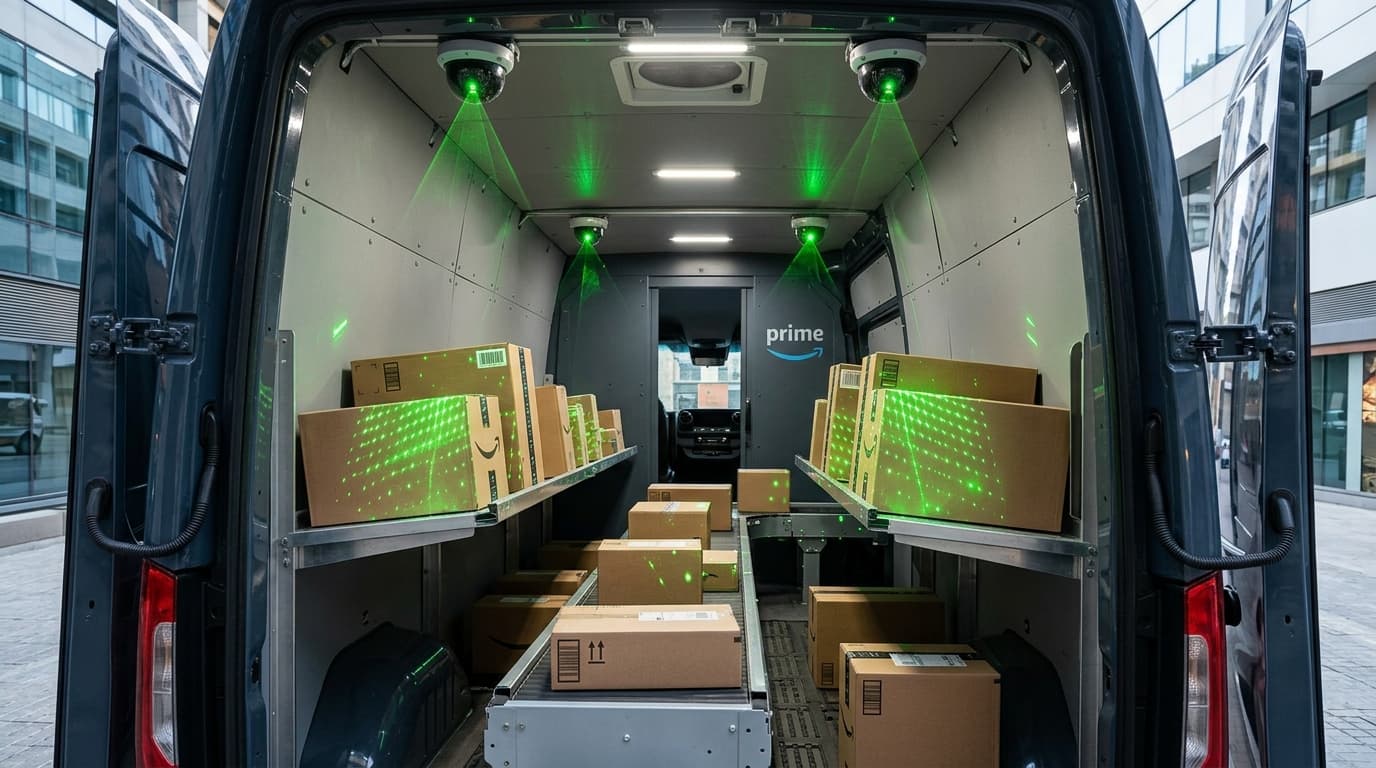
To resolve this systemic bottleneck, Amazon engineered Vision-Assisted Package Retrieval (VAPR), an edge computer vision solution embedded directly into its custom electric delivery fleet. The system synchronizes turn-by-turn route navigation with overhead cameras and optical projection modules mounted inside the cargo bay.
Upon reaching a designated stop, VAPR detects and decodes shipping labels across the cargo compartment in milliseconds. It then projects a bright green spotlight onto the specific parcels scheduled for immediate drop-off, while illuminating remaining cargo with a red indicator. Drivers can instantly retrieve the correct items without handling handheld scanning hardware.
Operational Metrics and Fatigue Reduction
Pre-deployment testing ahead of the planned 2025 rollout across 1,000 electric delivery vans demonstrated measurable operational gains. Automating parcel retrieval cut more than 30 minutes off standard driver routes by eliminating the cumulative minutes spent cross-referencing manifests and barcode tags.
Crucially, field trials also documented a significant reduction in physical and cognitive strain. Couriers spend considerably less time bent over in poorly lit cargo areas searching for misarranged boxes, minimizing handling mistakes and enabling consistent delivery schedules under high volume pressure.
Decentralizing AI to Fleet Edge Devices
The implementation of VAPR signals a broader shift in how retail and logistics enterprises deploy artificial intelligence. Rather than confining computer vision to fixed sorting centers or running route optimizers solely in cloud data centers, edge computing embeds intelligence directly at the physical point of fulfillment.
Operating models locally on vehicle hardware ensures resilience against sporadic network drops in underground parking garages, urban canyons, or rural drop-offs. The zero-latency response provides seamless feedback for drivers, ensuring uninterrupted workflows regardless of mobile carrier coverage.
- Indicative breakdown of last-mile stop activities; representative values for logistics analysis.
Implications for Southern European Hubs
The operational validation of in-van vision systems carries pressing relevance for Southern European logistics hubs, including Barcelona's Zona Franca and the El Prat freight corridors. Metropolises across Catalonia, Spain, and Europe are enacting strict low-emission zones (ZBE) alongside capped loading zone durations.
For regional carriers operating in dense urban centers like Barcelona or Madrid, where curbside dwell times are closely monitored by municipal systems, shaving 30 to 45 seconds off every stop can prevent parking violations and allow fleets to complete routes within permissible access windows without adding extra vehicles.
Evaluating Readiness for Visual Fleet Automation
Deploying in-vehicle computer vision requires a strategic evaluation of fleet hardware, back-office warehouse management systems (WMS), and parcel tagging protocols. Moving from handheld PDAs to edge optical detection demands clear architectural readiness and quantifiable return on investment metrics.
Logistics directors can use the diagnostic assessment below to evaluate their fleet operations and determine the most viable automation pathways for last-mile delivery.
How do your drivers currently identify packages inside delivery vans?
Strategic Outlook for Autonomous Last Mile
Amazon's targeted deployment of VAPR across 1,000 electric vans entering service in 2025 demonstrates that physical ergonomics and edge automation represent the next frontier of supply chain optimization. As optical sensors and neural processing accelerators become commoditized, these capabilities will expand beyond retail monoliths to 3PL operators and postal carriers.
For enterprise supply chains throughout Catalonia, Spain, and broader Europe, the key strategic takeaway is unmistakable: sustainable last-mile margin preservation requires automating the manual physical interactions inside the vehicle just as rigorously as routing software optimizes the path between stops.
“In-vehicle visual computing turns delivery cargo bays into real-time, automated sorting hubs on wheels.”